




The professional video production process is far more complex than it seems. Years of experience are required to master the craft of communicating a brand’s message through visual elements in a video.
Lighting, editing, animation, project cost, transitions between each frame, and the client’s requirements all count and can either make or break a brand’s public perception.
In this article, experts from the Zelios B2B video production agency explore some red flags and green flags to look for when choosing a corporate video production company. They also share practical steps you can take to see past a company’s glossy presentations and misleading corporate façade.
1. Define your Vision and Set a Goal
Defining your vision and setting up a goal must be your top priority. Knowing what you need is far more important than what they can produce (and by “they,” I mean your video production company). Many times, not having a clear vision of what you want to extract from a video production company ends up with continuous revisions and retakes, more project time, and obviously, more cost.
Ask yourself the following questions to define your goals:
- What’s the purpose of this video (brand awareness, training, product launch, recruitment)?
- Who is the target audience?
- What message do we want to communicate?
- What does success look like (engagement, conversions, brand lift)?
Having well-defined goals could give you a number of key traits to look for in your corporate video production company.
2. Evaluate Cultural Fit (The “Who”)
Whether the video is to demonstrate a product, engage an audience on social media, tell a story, humanize a brand, or just another campaign ad to build brand recognition, asking a third-party company to help you create a professional video is always a challenge, especially when there’s a cultural mismatch between the two. It is important to determine how the video production company handles a project.
Whether they employ full-time employees or rely mostly on freelancers, it is crucial to examine what’s their course of action during a project. Both team structures have their own pros and cons and both teams bring their own cultural values into the environment that can impact decision-making either in a positive or negative way.
3. Accessing Technical Expertise (The “How”)
The branding of such corporate video production companies can, sometimes, be misleading. A good branding doesn’t mean that they’ve good equipment to work with. You can access their technical expertise and their organizational discipline on what they have and how the utilize it.
First things first, the video production company must keep you posted throughout the process. There must be a clear path (project timeline and milestones) that both parties must be aware of. From pre-production planning to production processes and then post-production support, every stage tells a lot about the company.
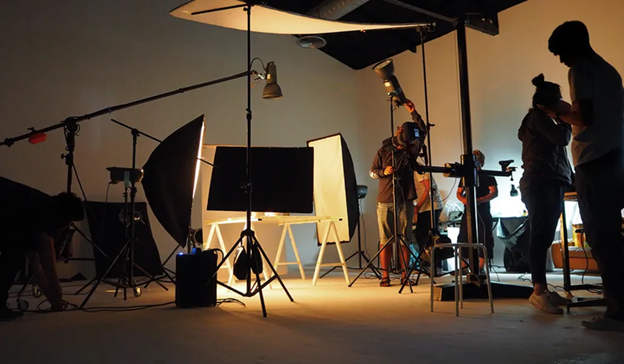
Ask what gear they use. From camera resolutions to the sound quality, everything matters. Lighting, cranes, drones, multi-camera shoots, gimbals, dollies, a variety of lenses, all of these equipment are extremely important, but they could be misleading as well.
Here are some questions that you need to ask from a corporate video production company:
- What stabilization equipment do you use for a smooth camera movement?
- Do you have access to a variety of lenses, like wide-angle, prime/fixed, telephoto?
- If our concept requires aerial shots, are you licensed and equipped to legally capture them?
- Do you rely on battery power, or do you bring portable generators for consistent lighting?
- Are you equipped to handle a multi-camera setup seamlessly?
- How do you back up the footage on set
- Are you able to deliver the final product in specific resolution and frame rate requirements?
- What industry-standard editing software and motion graphics tools do you use?
All of these questions might seem simple, but their answers might give you a ton of insights into the company’s expertise.
4. Budget, Costs, and Value Proposition
Instead of asking “How much does that cost overall,” you need to dig a little deeper. Ask for detailed and complete financial transparency with itemized quotes. These breakdown of cost should clearly mention equipment fee, crew rates, production hours, and every single fee that might occur during the project. This is important to avoid any unforeseen costs that might affect the project’s trajectory. Do not always choose the lowest bid, the price must be justified and documented before the production phase.
- Here’s a list of questions that might help you in that:
- How do they structure pricing (flat rate, packages, day rates)?
- What’s included in the estimate (crew, editing, revisions, travel)?
- Do they explain the value behind the cost?
- Can they tie their work to ROI or performance metrics?
If a company is offering to proceed with proper documentation and Certificate of Insurance, that’s a green flag, but still, you have to keep your eyes open.
5. Reg Flags to Avoid
Here are some signs that you MUST NOT ignore:
- Overpromising without realistic timelines? Red flag!
- Vague pricing with no breakdown? Red flag!
- Lack of reviews, references, or credible past clients? Red flag!
- If their price is significantly lower than the competition, that’s a red flag.
- If they claim they can do everything, from social media, graphic design, web development to video production, that’s a big red flag.
- If you feel like you’re being unheard, the communication isn’t going fluently, the company is hopping from one idea to another and rushing to close the deal, that’s a big, big red flag.
Final Words
Choosing the right video production company isn’t just about hiring someone with a good quality camera, it’s about finding a partner who knows how ‘branding’ works, how visions are put to life, and how to achieve business goals, realistically.
By considering the factors above, watch out for the red flags, don’t rush to close the deal, and take your time to make a smart and informed decision. For more info visit https://zelios.agency/